Sunday, 19 March 2023

North America’s Small Rainforest Cats


Mexico is home to six of North America’s seven wild feline species. From largest to smallest, they are the jaguar, cougar, bobcat, ocelot, jaguarundi, and margay.  The jaguar is very well known in the region and is likely the first animal that comes to mind when most people think of wild carnivores in Mexico or Central America.  This big, powerful cat is an apex predator throughout its range.  Two more, the cougar (known as puma in Latin America) and bobcat, have adapted to a wide variety of habitats and have established ranges further north in the United States and Canada. 

North America’s three smallest species - the ocelot, jaguarundi and margay - inhabit warm climates.  All three occupy similar ranges - from the tropical rainforests of Mexico, to most of Central America and the northern half of South America near the equator.   The ocelot is slightly smaller than a bobcat, and the jaguarundi and margay smaller still.  These three rainforest felines primarily hunt small prey weighing 1 kg (2.2 pounds) or less.  Thus, all are considered mesopredators - which means they are meat-eaters, but not top carnivores in the food web. While wildcats are carnivores, most animals that are classified as mesopredators are omnivores, eating both plants and meat.  Foxes, skunks and raccoons are three common mesopredators in North America.


Ocelot

These long-tailed cats are a little smaller than bobcats, weighing 15-33 pounds and standing 15-20 inches at the shoulder.  They are long and slender in build, with a 28-35 inch length not including the tail.  Ocelots have a distinct rosette spot pattern similar to the much larger jaguar.  They are agile tree climbers and hunt reptiles, birds and small mammals such as armadillos, rodents and rabbits.  As mesopredators, ocelots may have to watch out for alligators, jaguars, cougars or coyotes.  

The ocelot’s home range extends slightly further north compared to the jaguarundi and margay.  Very small populations exist in southern Arizona and Texas.  While this tiny United States population is endangered, the species as a whole is doing relatively well. Worldwide, the ocelot is a species of Least Concern and hunting them is banned in nearly every country where they reside, with the exception of Peru which allows regulated hunting.  Buying and selling ocelots or their pelts is also illegal in most countries.  In some areas, a pet trade for ocelots still persists, but not to the extent it once did. Historically, a coat made of ocelot fur could sell for thousands of dollars, and one captured live and taken from the wild for the pet trade could bring in $800.  However, ocelots are still vulnerable to human-caused threats - the primary one being habitat loss when forests are cut down. In the United States, vehicle traffic is a major threat to survival.  Ocelots require habitat with dense forest cover and plenty of water sources. They can live at high population densities, up to 161 ocelots per 100 square kilometers, but average 31 individuals within that same area. 


Margay 


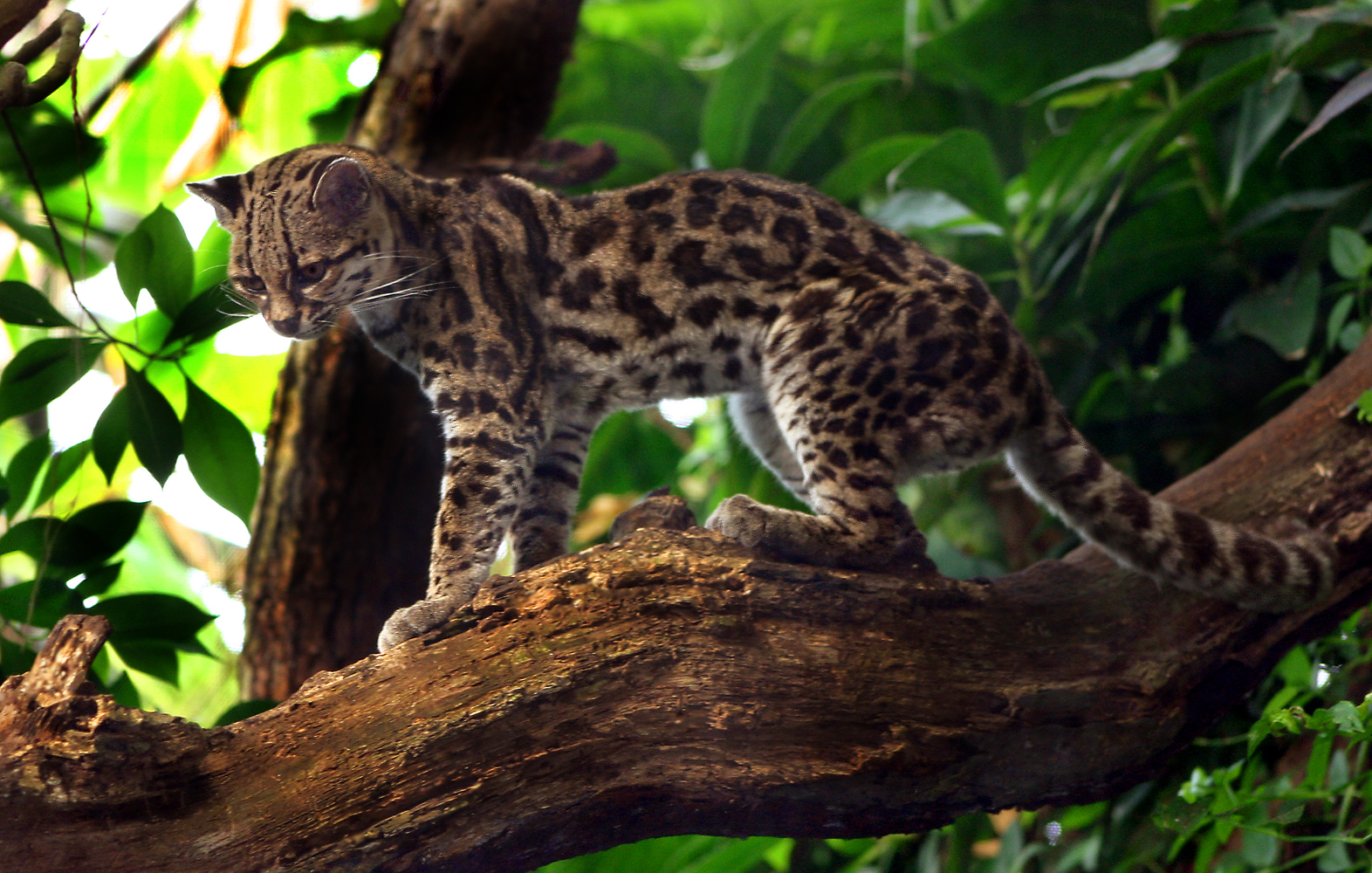
The diminutive margay is a cat built for life in the trees. These felines primarily hunt above ground, with their diet including fruit, eggs, birds, lizards, frogs and small monkeys. Thanks to their flexible hind legs that can rotate, the margay can run headfirst down a tree, just like a squirrel!  These spotted cats are quite similar in appearance to the ocelot and inhabit most of the same areas, except for the U.S./Mexico borderlands that comprise the northern edge of the ocelot’s range.  However, the margay is much smaller in size than the ocelot, with a typical 5-11 pound weight range and an 18-27 inch length not including the tail.  The legs and tail are also proportionally longer than the ocelot, an indicator of their adaptations to an arboreal life.  In some areas, they are known as “Tiger cats”. 

The margay is considered to be more vulnerable than the ocelot, and is listed as Near Threatened.  The species is fully protected across most of its range.  Vehicle collisions and poaching, which includes illegally hunting margays for their fur or taking them from the wild as pets, are threats to conservation.  As these cats prefer very dense forest habitat, which can include either evergreen or deciduous trees, they are also vulnerable to deforestation. Despite their small size, population density is quite low, with typically only 1-5 individuals per 100 square kilometers.  In a few areas, like the El Cielo Biosphere Reserve in Mexico, densities can reach up to 15-25 individuals in the same space.  For wild felines, population density varies depending on the quality of habitat - if habitat quality is high, there will be more cats within an area.  If food and cover are scarce, cats will have larger territories and occur at lower population densities.


Jaguarundi 


The jaguarundi doesn’t look much like a jaguar - they’re much more otter-like in build.  These little felines are one solid color with no spots.  The two common color phases are reddish and gray, with the rare black jaguarundi documented as well.  In size, they’re comparable to margays - weighing from 6-15 pounds and stretching 21-30 inches long, not including the tail.  Most cats are crepuscular- which means they are most active around dawn and dusk.  Jaguarundis, in contrast, mainly venture out during the daylight.  These felines hunt small prey mainly on the ground - which includes rodents, ground-feeding birds, reptiles, and frogs.  While they prefer ground hunting, jaguarundis are nevertheless skilled climbers.  

These small, elusive felines range from South America and Central America up to northern Mexico.  Unlike margays and ocelots, they can live in more open environments.  They are also more resilient to habitat disturbance.  Worldwide, jaguarundis are listed as a species of Least Concern.  They are protected in the majority of their range. Hunting them is prohibited by law in 15 out of 21 countries where they live.  Risks to these cats include habitat fragmentation and retaliatory killing by poultry farmers when jaguarundis kill and eat their chickens. The illegal fur trade is not a conservation threat to the jaguarundi. Unlike the spotted cats like the jaguar or ocelot, their pelts were never particularly sought after.  However, some are taken as pets.  Attempting to keep a jaguarundi or any wild cat species as a pet is a bad idea - it’s harmful to the cat and dangerous to the owner.

As their small size and secretive nature make them hard to count, it is unknown whether any currently exist in the United States.  A recent camera-trap Texas study makes a case that jaguarundis are extirpated in the United States, and that populations should be reintroduced to southern Texas.  Population densities per 100 square kilometers range from 1-5 jaguarundis in Brazil to 20 in Mexico.