
North America’s three smallest species - the ocelot, jaguarundi and margay - inhabit warm climates. All three occupy similar ranges - from the tropical rainforests of Mexico, to most of Central America and the northern half of South America near the equator. The ocelot is slightly smaller than a bobcat, and the jaguarundi and margay smaller still. These three rainforest felines primarily hunt small prey weighing 1 kg (2.2 pounds) or less. Thus, all are considered mesopredators - which means they are meat-eaters, but not top carnivores in the food web. While wildcats are carnivores, most animals that are classified as mesopredators are omnivores, eating both plants and meat. Foxes, skunks and raccoons are three common mesopredators in North America.
_-Belize_Zoo-6.jpg)
Ocelot
These long-tailed cats are a little smaller than bobcats, weighing 15-33 pounds and standing 15-20 inches at the shoulder. They are long and slender in build, with a 28-35 inch length not including the tail. Ocelots have a distinct rosette spot pattern similar to the much larger jaguar. They are agile tree climbers and hunt reptiles, birds and small mammals such as armadillos, rodents and rabbits. As mesopredators, ocelots may have to watch out for alligators, jaguars, cougars or coyotes.
The ocelot’s home range extends slightly further north compared to the jaguarundi and margay. Very small populations exist in southern Arizona and Texas. While this tiny United States population is endangered, the species as a whole is doing relatively well. Worldwide, the ocelot is a species of Least Concern and hunting them is banned in nearly every country where they reside, with the exception of Peru which allows regulated hunting. Buying and selling ocelots or their pelts is also illegal in most countries. In some areas, a pet trade for ocelots still persists, but not to the extent it once did. Historically, a coat made of ocelot fur could sell for thousands of dollars, and one captured live and taken from the wild for the pet trade could bring in $800. However, ocelots are still vulnerable to human-caused threats - the primary one being habitat loss when forests are cut down. In the United States, vehicle traffic is a major threat to survival. Ocelots require habitat with dense forest cover and plenty of water sources. They can live at high population densities, up to 161 ocelots per 100 square kilometers, but average 31 individuals within that same area.
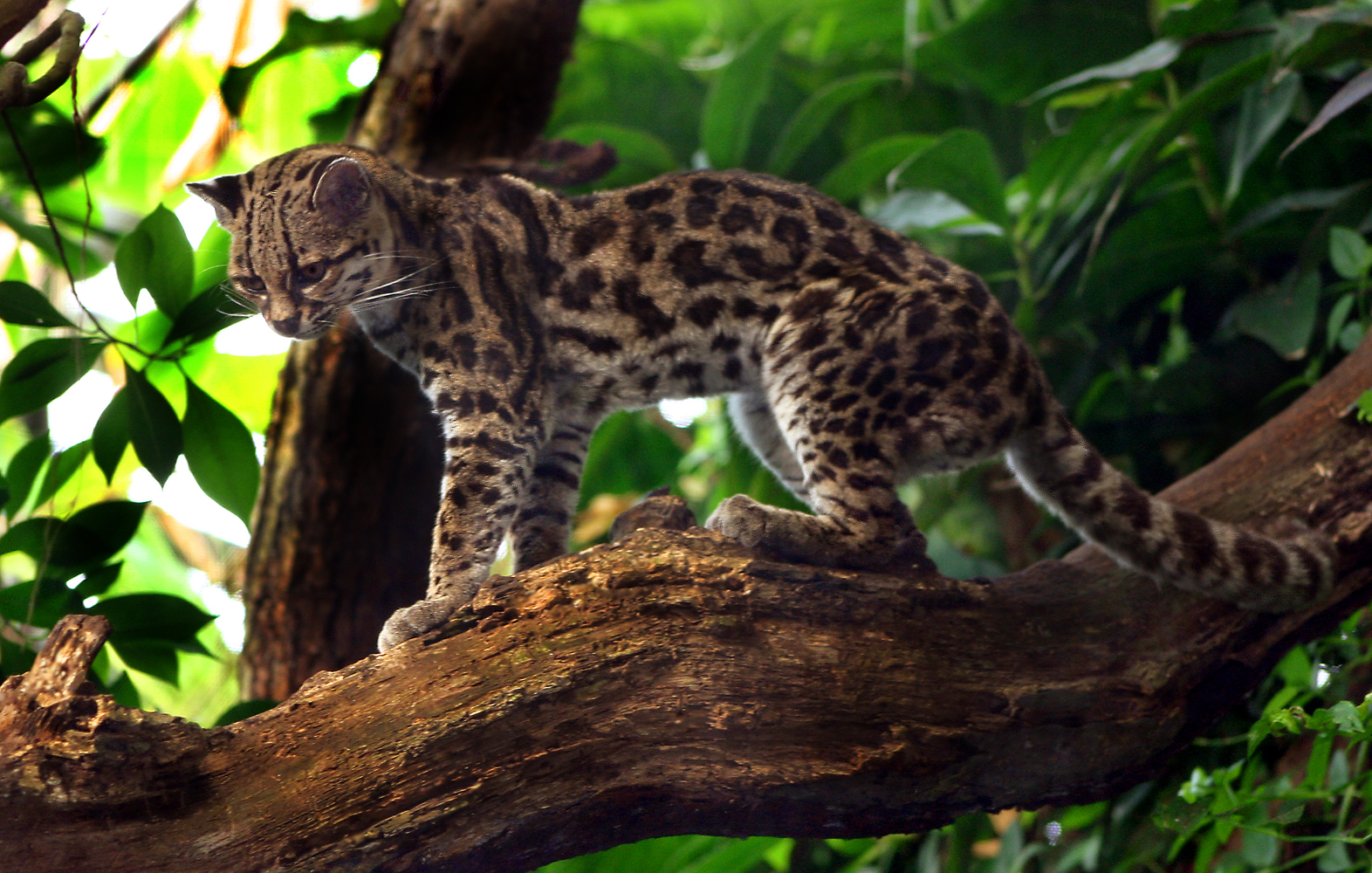
Margay
The margay is considered to be more vulnerable than the ocelot, and is listed as Near Threatened. The species is fully protected across most of its range. Vehicle collisions and poaching, which includes illegally hunting margays for their fur or taking them from the wild as pets, are threats to conservation. As these cats prefer very dense forest habitat, which can include either evergreen or deciduous trees, they are also vulnerable to deforestation. Despite their small size, population density is quite low, with typically only 1-5 individuals per 100 square kilometers. In a few areas, like the El Cielo Biosphere Reserve in Mexico, densities can reach up to 15-25 individuals in the same space. For wild felines, population density varies depending on the quality of habitat - if habitat quality is high, there will be more cats within an area. If food and cover are scarce, cats will have larger territories and occur at lower population densities.
